
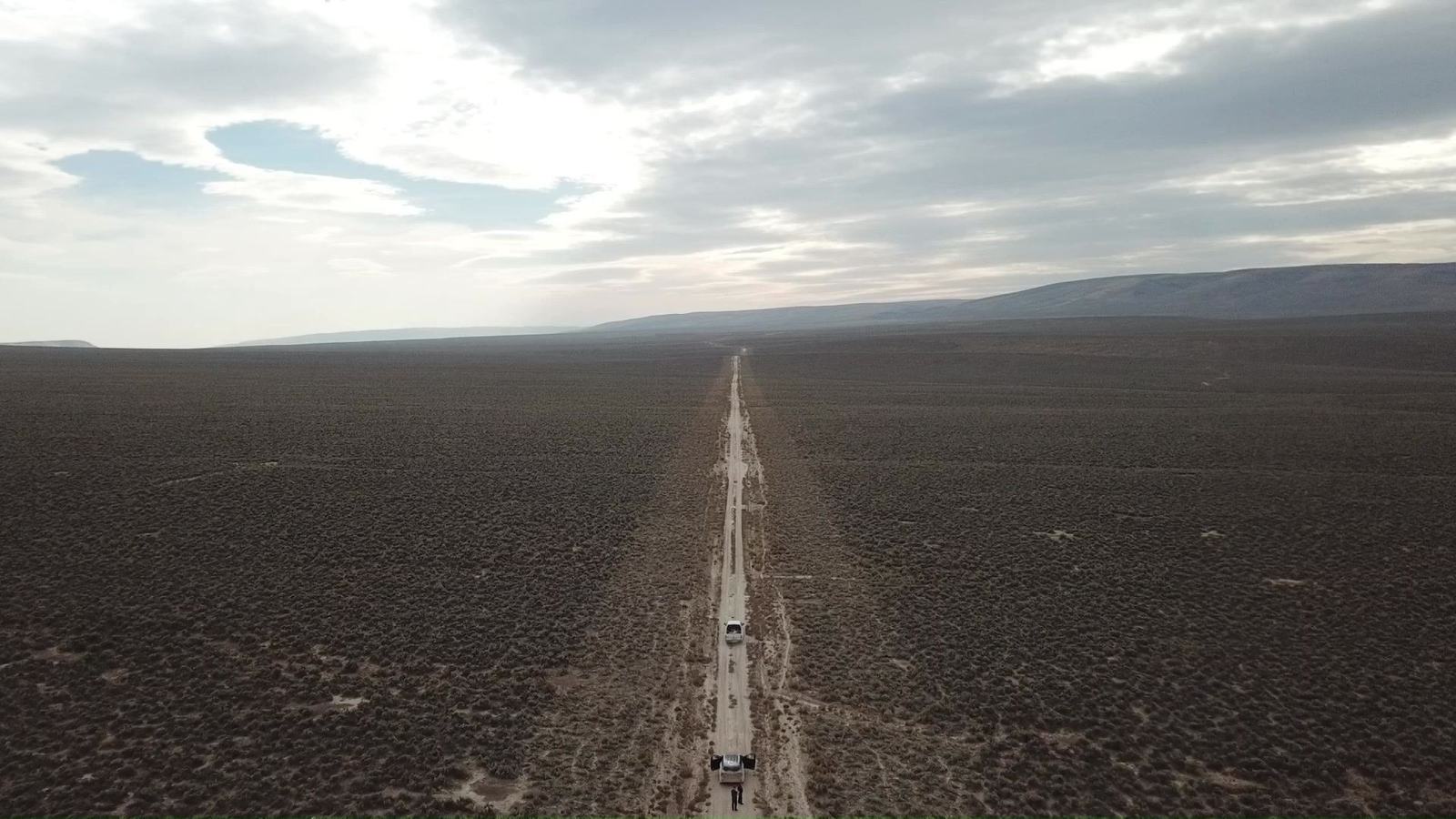
District geology · New Mexico
The Grants Uranium District
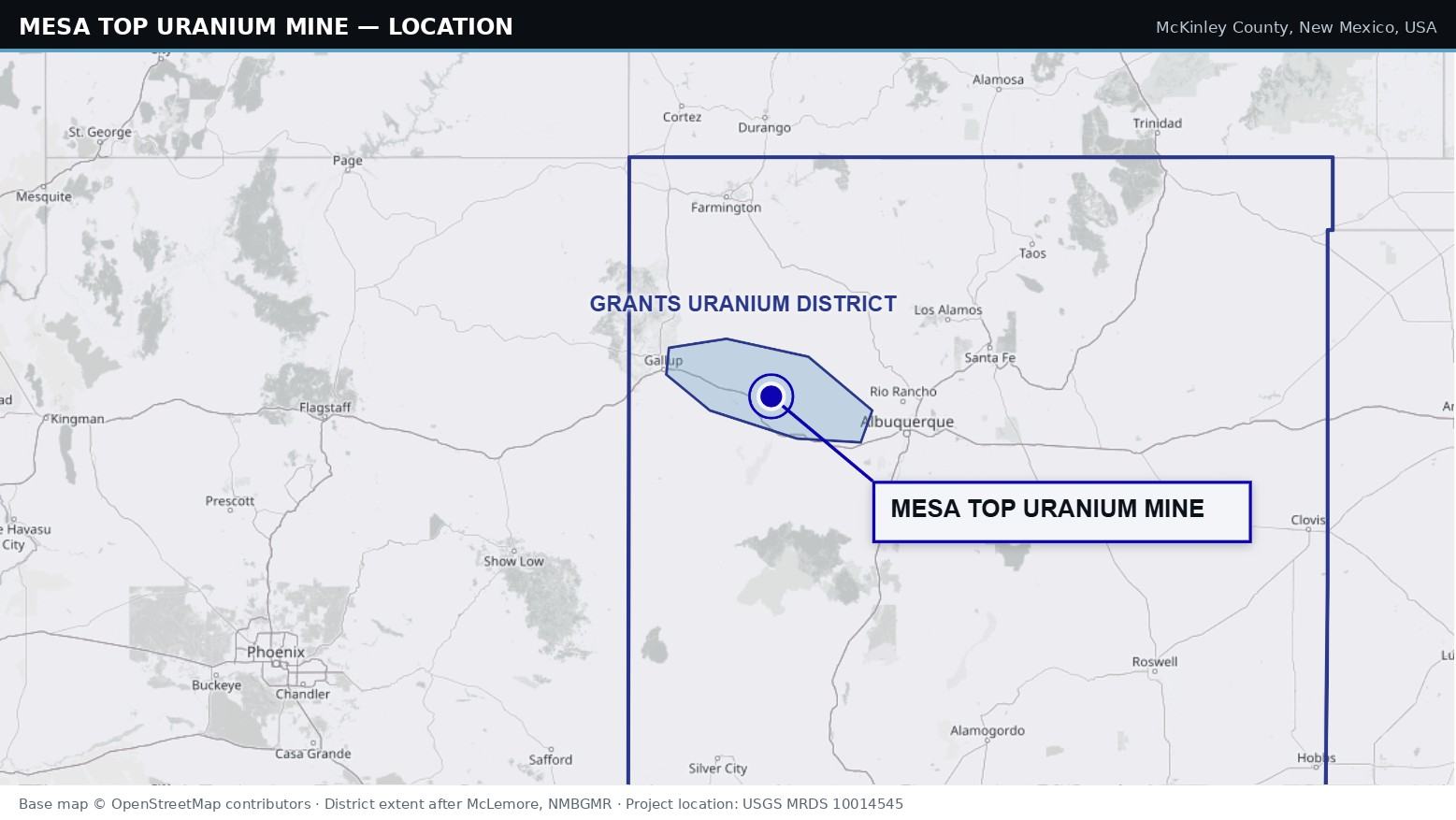
For nearly three decades the Grants district of northwestern New Mexico yielded more uranium than any other district in the United States. LiVE’s 100%-owned Mesa Top Uranium Mine sits inside its largest subdistrict.
The most productive uranium district in the US
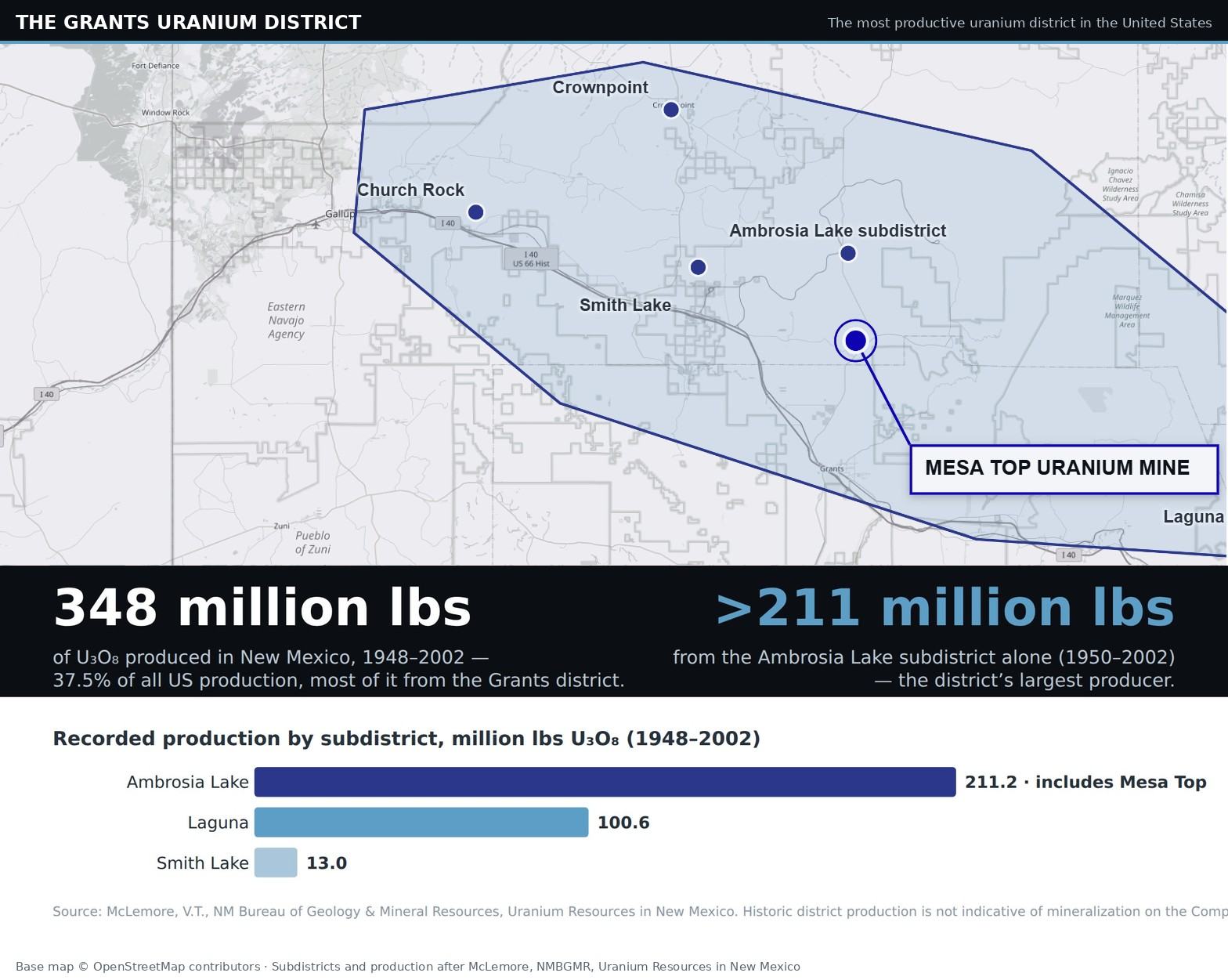
Between 1948 and 2002, New Mexico produced 348 million lbs of U3O8 — 37.5% of all uranium produced in the United States over that period — and nearly all of it came from the Grants district. From 1951 to 1980 the district out-produced every other uranium district in the country, and the New Mexico Bureau of Geology & Mineral Resources ranks it around seventh in total production among uranium districts worldwide.
The district — also called the Grants mineral belt — runs roughly 100 miles across the southern San Juan Basin, from east of Laguna to west of Gallup, through McKinley and Cibola counties. NMBGMR divides it into eight subdistricts: Laguna, Marquez, Bernabe Montaño, Ambrosia Lake, Smith Lake, Church Rock–Crownpoint, Nose Rock and Chaco Canyon.
Ambrosia Lake was the biggest of them. With more than 211 million lbs of recorded production it accounts for the majority of the district’s output — and it is the subdistrict that hosts the Mesa Top Uranium Mine.
| NM production, 1948–2002 | 348 million lbs U3O8 |
|---|---|
| Share of US production | 37.5% |
| US district ranking | #1, 1951–1980 |
| World ranking | ~7th in total production |
| Extent | ~100 miles, Laguna to Gallup |
| Subdistricts | Eight; Ambrosia Lake the largest at >211 million lbs |
| Main host | Westwater Canyon Member, Morrison Formation |
Why the uranium is here
The district lies on the Colorado Plateau, the physiographic province that dominates the Four Corners region and hosts the great sandstone-hosted uranium fields of the American Southwest. Colorado Plateau deposits have yielded over1.2 billion lbs of mined and in-situ U3O8, and a USGS assessment estimated a total endowment of 4.4 billion lbs in the Jurassic Westwater Canyon Member of the Morrison Formation alone — the main host unit in the Grants district.
Most of New Mexico’s production came from that member: fluvial sandstones deposited by Jurassic river systems, in which uranium carried by groundwater was fixed against organic-rich horizons to form tabular ore bodies, with later redistributed ore developed along fractures and redox fronts. In parts of the district, including the ground around the Mesa Top Uranium Mine, ore was also mined from the Poison Canyon sandstone of the Brushy Basin Member.
Production, not just potential
What distinguishes Grants from most exploration addresses is that its endowment is documented rather than inferred: decades of recorded production, published grades, and USGS Mineral Resources Data System case files on individual mines.
That record extends to LiVE’s ground. MRDS identifies eleven historic mine and prospect sites within the single section covered by the Company’s claims, resolving into two past-producing complexes — the Mesa Top Uranium Mine (108,261 tons of ore at a recorded grade of 0.24% U3O8, 1954–1968) and the Dog Group Uranium Mines (244,177 tons at 0.19%, 1957–1980) — a combined 352,438 tons of recorded production.
Qualified person
Adrian Smith, P.Geo., is a qualified person as defined in National Instrument 43-101 — Standards of Disclosure for Mineral Projects, and has reviewed and approved the scientific and technical information on this page.
Cautionary note
District and historic production figures on this page are drawn from public records and published sources and are provided for geological context only. They are not necessarily indicative of mineralization on the Company’s claims. The Company is an exploration stage company and has no mineral resources or reserves on any of its properties. There is no assurance that exploration will result in the delineation of a mineral resource.
References
District production, extent, subdistricts and rankings: McLemore, V.T., New Mexico Bureau of Geology & Mineral Resources, Uranium Resources in New Mexico. Colorado Plateau production and Westwater Canyon endowment: S.M. Hall, et al., 2023, Sandstone-hosted uranium deposits of the Colorado Plateau, USA, Ore Geology Reviews, Volume 155. Mine-level historic production: USGS Mineral Resources Data System, deposit ID 10014545 (Mesa Top Mine) and deposit ID 10014547 (Dog Group Mines).